S_PF.02 · 00 / OPENING
A Common Share
Continuous assistance in money and time, carried by agents, decided by people
What if solidarity rode the subscription economy, and an agent carried the standard that governs it, in money and in time?
A Common Share imagines mutual aid in 2040 as continuous assistance shared through money and time. It builds on CASt — Continuous Assistance Standard v0.1, an independent, transferable impact standard first presented in The Infrastructure of Solidarity. This prefiguration imagines a fictional extension of CASt that adds donated time to monetary assistance, while keeping its focus on people facing economic precarity. People and local nonprofits remain responsible for decisions about who receives help and how it is delivered. The history and present-day signals are real; the 2040 system and its consequences are speculative. The existing Standard remains unchanged.
A standard is a shared set of commitments and measures. Different organizations use it to describe what they aim to achieve and assess their impact using shared measures, while each keeps the freedom to decide how it delivers its services. Think of the Fairtrade mark: producers work in different contexts, but common requirements define what Fairtrade certification means, and independent audits check whether those requirements are met. CASt applies that idea to continuous assistance — help that arrives regularly and predictably, rather than just once — by setting commitments and measures for its continuity and impact.

- Subscription-based platforms contribute. Each commits a share of its revenue every month.
- An agent carries the standard. Here, an agent is software that acts on a contributor’s instructions and follows the standard’s rules: it directs the contributions they choose and offers their available time for tasks published by local nonprofits. It does not assess need or decide who receives help; people at local nonprofits make those decisions.
- Circles co-create. Neighbours, colleagues, or a parish shape projects with local nonprofits; the nonprofits decide how assistance is delivered.
- Time counts as time. An hour given is recorded as an hour, alongside money and never converted into it.
The agent carries rules, directs contributions and offers your hours. You choose the task; the nonprofit decides how help is delivered.
Contents
S_PF.02 · 01 / EUROPE’S MISSION
Europe’s mission
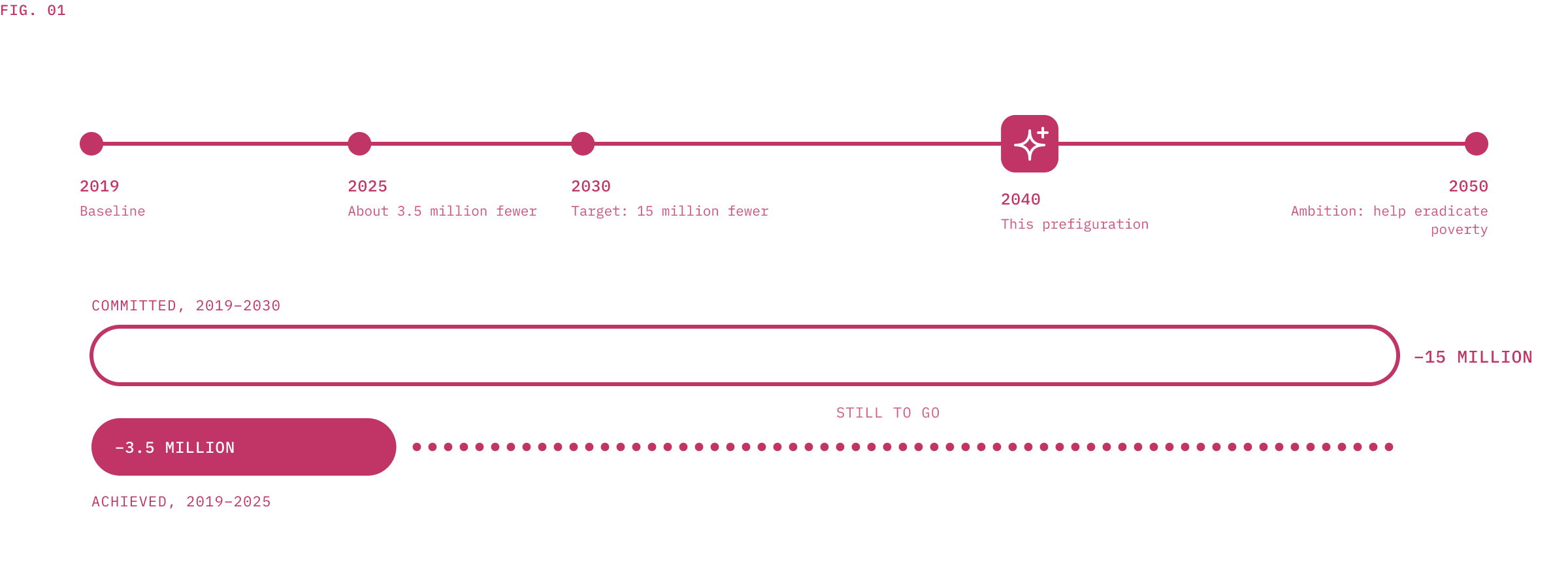
Europe has committed to cutting poverty, and it is falling behind. That gap is the reason this prefiguration exists.
By the numbers
| Figure | What it measures | Source |
|---|---|---|
| 92.7 million | People in the EU at risk of poverty or social exclusion in 2025, 20.9% of the population | Eurostat, 30 April 2026 |
| 19.3 million | Children among them | Commission factsheet on the Anti-Poverty Strategy, May 2026 |
| −15 million | The 2030 target against 2019, including at least 5 million children | European Pillar of Social Rights Action Plan |
| −3.5 million | The change between 2019 and 2025 | European Commission, EU Anti-Poverty Strategy, May 2026 |
| 2050 | The Anti-Poverty Strategy’s ambition to help eradicate poverty | European Commission, EU Anti-Poverty Strategy, presented 6 May 2026 |
Why this prefiguration answers to it
On 6 May 2026 the Commission presented the EU’s first Anti-Poverty Strategy. It includes a coalition against poverty, dialogue with people experiencing poverty, and a 2027 proposal on easier and integrated access to services.
The Strategy asks for coordination across public, civic and private actors. A Common Share imagines what that coordination could look like in 2040: platforms contributing from revenue, citizens organized in circles, time counted alongside money, and public budgets building the shared rails. It sits halfway to 2050.
These policy commitments are the context for the speculation; they do not endorse it.
S_PF.02 · 02 / THE 2040 SYSTEM
The 2040 system
Projected from grounded signals (sections 01, 04 and 05). Subscription-based platforms pay from their own revenue; contributors direct where it goes. Your agent carries the contributor’s instructions and the standard’s rules, and offers their available time against published tasks. Circles co-create projects with local nonprofits, and the nonprofits decide how help is delivered.
On the platform side, an impact agent receives the request, sees only the amount and never where it goes, and pays the pool. Money goes from platforms straight to a steward pool at a regulated bank; neither the agent nor the circles ever hold it. The bank pays out the money; service providers are paid to deliver. Time goes from a person to a task a nonprofit published, and the person chooses whether to take it.

The line. Everything the agent does sits on the incoming side: finding platform shares, carrying out the contributor’s instructions, offering hours. Everything about need sits with the local nonprofit and is decided by people.
The common floor. A fixed share of every circle’s allocation goes to a common floor, which funds co-created projects first where circles are few or absent. There a nonprofit starts the project and circles from elsewhere can adopt it.
Reciprocity. A person who receives assistance this winter may give two hours next spring. Receiving is not a fixed status.
S_PF.02 · 03 / A WEEK IN 2040
A week in 2040

Your circle voted. This month’s share, €3.20 from your subscriptions, goes to the winter heating project.
Casa Aperta published a task: help with forms, Tuesday 18:00, two hours. Take it?
Yes. Tuesday works.
S_PF.02 · 04 / ROOTS
Roots
The 2040 system has a past in Piedmont. It is mutual aid, with agents doing the clerical work.

Società di mutuo soccorso
Members paid small regular dues into a common fund, topped up by philanthropists. The fund covered illness, injury, death and unemployment, and over time education and small loans. Their novelty was a secular principle of assistance in place of charity.
An official count of 82 societies, cited for 1862, found them mainly in Piedmont. By 1885, 707 of the 3,762 societies answering the national survey were Piedmontese, about 19%.
Banche dei tempi
Italian law has recognized time banks since 2000. Law 53 of 8 March 2000, Art. 27, lets local authorities support associations where residents exchange time for mutual help, and adds that these activities cannot take the place of the authorities’ own institutional duties. That is the same boundary CASt draws between community assistance and public provision.
What carries over
- Dues become platform shares that contributors direct.
- The common fund becomes the steward pool.
- Members both give and receive.
- Time is counted as time.
S_PF.02 · 05 / SIGNALS AND DRIVERS
Signals and drivers
The speculation starts from things already visible. Signals are early examples of the 2040 system; drivers are forces likely to shape it.
Signals already visible
| Signal | What it shows | Source |
|---|---|---|
| Subscriptions are ordinary | 32.7% of EU internet users held a paid streaming subscription in 2025 | Eurostat, 27 August 2026 |
| Businesses give a share of revenue | Since October 2020, businesses on Stripe can direct a share of their revenue to carbon removal in a few clicks, without writing code | Stripe, Stripe Climate launch, 28 October 2020 |
| Software carries out payments | Mastercard unveiled Agent Pay in April 2025; on 2 June 2026 Worldline, ING and Mastercard announced what they describe as Europe’s first end-to-end agentic payment in production | Mastercard press releases, April 2025 and June 2026 |
| People give together | Nearly 4,000 US giving circles and collective giving groups, with more than 370,000 members, gave over $3.1 billion between 2017 and 2023, up from about 1,600 groups in 2017 | Philanthropy Together, In Abundance (2024), via Inside Philanthropy |
| Small gestures add up | In 2025, shoppers in France made more than 38 million checkout micro-donations through MicroDON’s L’ARRONDI, raising almost €15 million | La Poste Groupe press release, 2 February 2026 |
| Communities share energy | 3,315 renewable energy communities were operating in Italy at 31 May 2026 | PNIEC monitoring platform, GSE data, reported by Teleborsa, July 2026 |
Drivers toward 2040
| Driver | Status today | Why it matters |
|---|---|---|
| Agentic payments | Agent-initiated payments began running on European bank rails in 2026 | An agent that carries the standard becomes technically ordinary |
| The digital euro | On 9 July 2026 the European Parliament voted to open negotiations with the Council; the ECB says a pilot could start in 2027 if the law is adopted in 2026 | A public rail that lowers the cost of moving small amounts |
| The Social Climate Fund | At least €86.7 billion from 2026 to 2032, including national co-financing, for energy and transport poverty | Energy poverty becomes a funded policy field next to poverty itself |
| Ageing | The EU’s median age reached 44.9 on 1 January 2025 | More people on fixed incomes, and more people with time to give |
| A 2050 horizon | The Anti-Poverty Strategy aims to help eradicate poverty by 2050 | A long horizon within which new infrastructure can be imagined and tested |
S_PF.02 · 06 / THE AGENT AND ITS LIMITS
The agent and its limits
The agent executes a contributor’s own instructions. It does not evaluate, decide on or hold data about any person receiving assistance. Those decisions belong to the local nonprofit and are taken by people.

How this maps to the AI Act
| Provision | What it covers | The agent |
|---|---|---|
| Annex III, point 5(a) | Systems used by or on behalf of public authorities to evaluate eligibility for essential public assistance, or to grant, reduce, revoke or reclaim it | Not used by or on behalf of a public authority, and performs none of these functions |
| Annex III, point 5(b) | Systems that evaluate creditworthiness or set credit scores | Evaluates no one’s creditworthiness |
| Article 6(3) | Exemptions for Annex III systems, and the rule that profiling of natural persons is always high-risk | Not an Annex III system, so the exemption is not relied on. Profiling is excluded by design in any case |
Outside CASt’s scope. If a local nonprofit chose to use AI tools in its own casework, those tools would be assessed under the AI Act on their own terms. CASt neither requires nor supplies them.
Status: our reading, written for review, to be confirmed by counsel and checked against the Commission’s guidance on high-risk classification. Source: AI Act Service Desk, Annex III and Article 6.
S_PF.02 · 07 / WHO GOVERNS THE AGENTS
Who governs the agents
People govern and maintain the standard; agents carry its rules. That holds for contributors’ agents and for platforms’ impact agents alike. Because agents act on the standard’s behalf, someone must certify them, audit them and be able to withdraw them.

| Role | What it does |
|---|---|
| Standard body | Keeps and versions the published text. Seats for local nonprofits, people with lived experience of precarity, circles and platforms; public bodies observe. No group holds a majority alone. |
| Independent assessors | Test agents and platforms against the published text before they may carry the CASt mark. |
| Public registry | Lists every conforming agent and platform, with the date its certificate expires. |
| Contributors and nonprofits | Can file a complaint about an agent or a platform; an independent review decides. |
Rules for the agents
- Certificates are time-bound. They expire and must be renewed, like the cast that comes off when it is no longer needed.
- Behaviour is auditable. Agents keep logs that assessors can check, in aggregate and without personal data about people receiving assistance.
- Withdrawal is public. A withdrawn agent leaves the registry the same day.
- Leaving is safe. A contributor’s instructions, circles and hours move to another conforming agent without loss.
- Public responsibility stays separate. Public bodies may reference the standard. They do not run it, so statutory duties never move onto it.
S_PF.02 · 08 / CIRCLES, TIME AND THE CLAUSES
Circles, time and the clauses
Circles co-create projects with local nonprofits, never choosing individuals. Circles bring money, hours and local knowledge and shape what a project is for; the nonprofit decides who is helped, how much and for how long.

Time, the hardest part
Money can pass through institutions and stay anonymous. Volunteering connects people directly. That makes time the hardest part of the design, not an add-on to money.
Safeguarding
Every task that brings a volunteer into contact with a person receiving assistance is published, matched and supervised by the nonprofit. The agent shares when, where and what kind of help; never contact details or anyone’s situation.
Access
Carers, people working several jobs, and people with disabilities or poor health take part fully through money alone, or through tasks that fit them. People receiving assistance may give time; they are never expected to.
Substitution
Unpaid hours must not replace professional care or public services. Italian law draws this line for time banks (Law 53/2000, Art. 27); CASt keeps it, and the standard body watches for volunteer hours growing as paid posts shrink.
Draft clauses
Working wording for the fictional extension of CASt, not final text and not changes to CASt v0.1. Each clause stages a choice readers can argue with.
- C01Agent
The agent carries the rules, directs contributions and offers a person’s availability against published tasks. It MUST NOT decide who is helped, how help is delivered, for how long, or when it ends.
- C02Agent
The agent MUST run on the contributor’s side. The steward entity receives only amounts, hours and the chosen pool, never the list of subscriptions. Access MAY be revoked at any time.
- C03Agent
The published text is the source of truth. Every agent MUST be auditable against it.
- C04Platforms
A platform MUST commit a minimum annual contribution, whatever its churn. Retention MAY raise the amount; it MUST NOT interrupt an assistance period already started.
- C05Platforms
No single platform SHOULD fund more than a set share of any one pool.
- C06Platforms
Platforms MAY show subscribers the impact of staying, only in aggregate and never based on a subscriber’s own directions. They MUST NOT show it at the moment of cancellation.
- C07Platforms
A platform’s impact agent MUST honour directed requests within the platform’s committed share, and MUST pay the steward pool directly.
- C08Platforms
A platform’s impact agent receives only the amount requested, never where it goes.
- C09Platforms
It MUST NOT use contributors’ directions for marketing, retention targeting or pricing.
- C10Platforms
It MUST NOT choose, rank or decline causes, circles or projects.
- C11Platforms
It is certified, audited and can be withdrawn like any other agent, and publishes aggregate figures only.
- C12Circles
Circles co-create; nonprofits decide. A circle MAY co-create a project with a local nonprofit and choose its purpose and area. It MUST NOT choose individuals.
- C13Circles
A fixed share of every circle’s allocation MUST go to a common floor. The common floor MUST fund co-created projects first where circles are few or absent.
- C14Providers
Service providers are paid to deliver. They MUST NOT co-design the projects they supply.
- C15Money
Pooled money MUST be held by a regulated financial institution in a ring-fenced account. Identity checks on people receiving assistance stay with that institution and the nonprofit.
- C16Time
An hour is an hour. Time MUST NOT be converted into money or ranked by task.
- C17Time
Donated time complements professional care. It MUST NOT replace paid social work or statutory duties.
- C18Time
Tasks that bring a volunteer into contact with a person receiving assistance MUST be matched, briefed and supervised by the nonprofit.
- C19Time
A person MAY decline any task without consequence. No one’s assistance MAY depend on giving time.
- C20Time
The agent shares only what a task needs, never a person’s file.
- C21Reciprocity
A person who receives assistance MAY also give time, now or later. Receiving is not a fixed status.
S_PF.02 · 09 / TECHNOLOGY PREMISE
Technology premise
CASt’s technology must leave more than it takes. Clean is the floor; regenerative is the aim.
| Area | Clause |
|---|---|
| Energy | Agents, pools and reporting MUST run on renewable electricity matched hour by hour, not offset once a year. |
| Sufficiency | The agent SHOULD act on a schedule rather than continuously, and use the smallest model that does the task, on the person’s own device where possible. |
| Budget | Every implementation MUST stay within a published compute and energy budget per participant, and report against it each year. |
| Data | Collect only what each task needs. No sale of data, no advertising, no profiling of contributors or of people receiving assistance. |
| Openness | The rules, the agent’s code and its audits MUST be open. Anyone may run a conforming agent. |
| Hardware | Taking part MUST NOT require buying a device. Implementations SHOULD favour long-lived, repairable hardware. |
| Access | Every function MUST also be reachable without a smartphone, through a local nonprofit or a public office. |
| Regeneration | A share of the operator’s fee SHOULD fund local renewable energy communities whose social share reaches households in energy poverty. |
Regenerative, not only clean. Under ministerial decree 414 of 7 December 2023, any premium tariff a renewable energy community earns above the set threshold must go to non-business consumers or to social purposes in the area where the plants stand. In 2040, CASt’s agents could run on those communities, and their social share could flow into the same steward pools to address energy poverty.
The tension to keep visible. Millions of agents use real energy. A standard cannot promise zero impact; it can measure it, cap it and publish it.
S_PF.02 · 10 / WHAT IT COSTS
What it costs
Public money builds the rails; solidarity fills the pool. Public budgets at EU, national, regional and local level each pay for part of the shared infrastructure; assistance itself is paid by platform shares that contributors direct.

Why split it this way. It keeps public responsibility visible: public funds never quietly become charity. It lets funds from AI, energy and digital budgets support CASt without bending their purpose. And assistance does not stop when a seven-year budget cycle ends.
Who does what, level by level
EU. Funds programmes and sets the frame: ESF+, the Social Climate Fund, Digital Europe and, from 2028, the national and regional partnership plans. Pays for the open agent, clean compute and independent evaluation.
National. Ministries and managing authorities channel EU funds, set the tax treatment of platform shares and the rules on volunteering, and keep statutory welfare, which CASt never replaces.
Regional. Regional ESF+ programmes and energy plans co-fund casework, volunteer matching and safeguarding, and the energy communities that power the agents.
Local. Municipal social services keep their statutory duties and their own referrals. They can host offline access points in public offices, convene circles and nonprofits, and co-fund local casework. They observe the standard; they do not run it.
Cost lines and who pays
| Cost line | What it pays for | Proposed payer |
|---|---|---|
| The agent as a commons | Building, maintaining and auditing open agents and the standard’s code | Public digital and AI budgets |
| Clean compute | Renewable energy and hosting for agents and pools | Energy communities and energy-transition funds |
| Steward pools | Custody, payments, reporting | The disclosed operator fee |
| Assistance | Money delivered to people, period by period | Platform shares directed by contributors; any public co-funding named in reporting |
| Local casework and time | Nonprofits’ staff time, matching volunteers, safeguarding | Regional ESF+ programmes and local social budgets |
| Governance | The multi-stakeholder body that keeps the standard | Shared: public, platforms, foundations |
| Learning | Independent evaluation and research | Research programmes |
EU instruments today
Signals as of November 2026, not commitments to CASt. By 2040 a later budget cycle will apply.
| Instrument | Period | Size | Relevance |
|---|---|---|---|
| ESF+ | 2021–2027 | €95.8 billion | At least 25% for social inclusion and at least 3% for material deprivation in every Member State |
| Social Climate Fund | 2026–2032 | At least €86.7 billion | Energy poverty, transport poverty and temporary direct income support |
| Digital Europe Programme | 2021–2027 | Over €8.1 billion | AI, cybersecurity, supercomputing, digital skills |
| InvestAI | From 2025 | €200 billion to mobilise, incl. a €20 billion AI gigafactories fund | Public-private AI investment; where an open civic agent could sit |
| MFF proposal | 2028–2034 | Nearly €2 trillion | Proposed 16 July 2025; still to be agreed unanimously by the Council |
| National and Regional Partnership Plans | 2028–2034 | National allocations, at least 14% for skills, poverty reduction and social inclusion | Where poverty reduction and social inclusion would be funded |
| European Competitiveness Fund | 2028–2034 | €409 billion | Research, innovation, digital |
| Digital euro | In legislation | No EU budget line | A public payment rail run by the central bank; it would lower the cost of moving small amounts |
Tensions
- Mission drift. AI and energy funds want showcases. CASt has to take their money without becoming their demo.
- Budget cycles against continuity. Public funds come in seven-year cycles. That is why they pay for the rails, not for assistance periods.
- Who applies. EU money flows through national and regional managing authorities. Who holds the grant: the standard’s body, a city, or each implementation?
S_PF.02 · 11 / WHAT IT CHANGES
What it changes
Six dimensions, one for each kind of participant and one for time. Evidence is reported only in aggregate. Experiences are gathered through voluntary, anonymous feedback collected by an independent evaluator, never linked to a person over time.
| Dimension | Question | Evidence required |
|---|---|---|
| Individual | Does assistance arrive more reliably and help people meet essential costs? Do people experience choice, dignity and a greater ability to plan? | Planned versus missed deliveries; voluntary, anonymous feedback on stability, dignity and autonomy, reported only in aggregate and never linked to a person over time |
| Nonprofit | Do predictable resources and offered hours help local nonprofits plan and accompany people? Do shared tools add reporting work? | Funding predictability; continuity of planned activity; staff time spent on coordination |
| Contributor | Does delegating to an agent keep people engaged, or does giving fade into the background? | Participation and pauses over time; how often people review their circles; qualitative accounts of motivation |
| Ecosystem | Do circles and the common floor spread resources to places without circles? Do they blur public responsibility? | Distribution of funds across areas; documented changes in referrals and gaps |
| Platform | Do platform commitments hold when revenue falls or strategy changes? Does the solidarity share stay separate from retention marketing? | Committed versus delivered shares over time; commitments kept through downturns, price changes and changes of ownership; conformance reports on the cancellation-screen clause |
| Time | Does counting time build reciprocity? Do people who received assistance later give time? | Hours offered and used; voluntary accounts of giving after receiving |
S_PF.02 · 12 / TENSIONS TO STAGE
Tensions to stage
The piece shows these and leaves them open. A prefiguration earns its keep by making the trade-offs visible.
- The platform’s motive, the central tension. A platform’s contribution may be good for solidarity and good for retention at the same time. Is care bundled with a music service still solidarity, or customer experience? In 2040 the platform’s own impact agent sits at this seam: it sees how much each subscriber directs, and the clauses forbid it from using that to keep them. The piece keeps the ambiguity in view; it is part of the concept’s force.
- Retention economics next to need. Platforms give partly so people stay. A person’s continuity sits downstream of someone else’s growth targets.
- The act moves. If an agent gives, the human act becomes choosing your circles and your hours. Is that a loss, or how solidarity survives?
- Circles fund their own. Need is unevenly spread, and well-off circles cluster in well-off places. The common floor is one answer; readers may want a stronger one.
- Agents as collective power. Millions of agents asking platforms to commit shares work like a union of consumers. Who governs that power?
- Who builds the agent. Many conforming agents, or one dominant one. A single provider becomes a gatekeeper of solidarity.
- Time meets people. Money can stay anonymous; time cannot. Safeguarding, access and substitution (section 08) should be shown, not claimed as settled.
- Not the digital welfare state. The agent works only on what comes in. Need is never scored by a machine.
The agent carries rules, directs contributions and offers your hours. You choose the task; the nonprofit decides how help is delivered.
S_PF.02 · 13 / OPEN QUESTIONS: GROUNDING
Open questions: grounding
The prefiguration stays speculative; the arguments under it should not. These are the real-world questions that would make or break the 2040 scenario.
| Theme | Question | Why it matters | How we would ground it |
|---|---|---|---|
| Platform incentive | Does a visible solidarity share reduce churn? | The anti-churn premise carries the platform side | Published studies on cause-linked retention; a controlled test with one subscription business |
| Scale | How much could platform shares produce in one city? | Tells us whether pools can promise 8-week periods | A model: local subscriptions × plausible share rates, low / middle / high |
| Downturns | How do subscription revenues move in a recession, compared with need? | The cyclical tension | Historical churn and revenue data from past downturns |
| Accounting and tax | Would a platform book its share as a donation, a sponsorship or a marketing cost? | Shapes what platforms are willing to commit | Tax advice per country; Italy’s Third Sector Code |
| App stores | Can subscriptions billed through app stores carry a solidarity share? | A large part of digital subscriptions runs through them | Apple and Google rules; the effects of the Digital Markets Act |
| Data access | Can a personal agent lawfully see all of someone’s subscriptions? | The agent depends on it | GDPR consent rules; EU open-finance and payment-services legislation in progress |
| AI regulation | How does the AI Act classify the agent? | The agent must sit clearly outside the high-risk use cases (section 06) | Review by counsel; the Commission’s AI Act Service Desk and guidance |
| Liability | Who answers when an agent directs money or offers time wrongly? | Trust in agents that carry the standard | Liability rules for software and for agent-initiated payments |
| Energy | How much energy does one person’s agent use in a year? | The energy budget clause needs a number | Measured benchmarks for small, scheduled models |
| Energy communities | Can a renewable energy community’s social share flow into an assistance pool? | The regenerative loop | GSE rules under DM 414/2023 |
| Volunteers | What protections do people giving time need: insurance, training, safeguarding? | Time meets people | Italian third-sector rules on volunteers; practice in existing time banks |
| Circles | What legal form does a giving circle take, and can it direct funds without holding them? | Circles direct; pools hold | Italian association law; models from existing giving circles |
| Public funds | Which managing authority could fund the shared infrastructure? | The cost model | Conversations with regional ESF+ and energy-fund authorities |
S_PF.02 · 14 / DESIGN CHOICES AND SOURCES
Design choices and sources
Design choices
- Horizon: 2040 like Prefiguration 01, or later (2045) so the two read as a sequence?
- Version: inside the fiction, is the extension named as a CASt variant or as a later version?
- Directed share: how much of each subscription can a contributor direct, and who sets the cap?
- Name for the person’s role: contributor, member, or attributor?
- Size of the common floor and of the cap on any one platform’s share of a pool.
- Should the fictional extension also cover in-kind help (goods), or stop at money and time?
Sources
- Eurostat, news release on poverty or social exclusion, 30 April 2026
- European Commission, EU Anti-Poverty Strategy, presented 6 May 2026
- European Commission, factsheet on the EU Anti-Poverty Strategy, May 2026
- European Pillar of Social Rights Action Plan
- Biblioteca Liberale, Mutualismo e cooperazione
- ISTAT, Statistica delle società di mutuo soccorso, 1885
- Legge 8 marzo 2000, n. 53, Art. 27 (Banche dei tempi)
- Assolombarda, Decreto CER: DM MASE 414 del 7 dicembre 2023
- Eurostat, paid online subscriptions, 27 August 2026
- Stripe, Stripe Climate launch, 28 October 2020
- Mastercard, Worldline and ING, press release, 2 June 2026
- Philanthropy Together, In Abundance (2024), via Inside Philanthropy
- La Poste Groupe, L’ARRONDI en caisse 2025, 2 February 2026
- Teleborsa, renewable energy communities in operation, July 2026
- European Commission, ESF+ data and figures
- European Commission, Social Climate Fund
- European Commission, Digital Europe Programme
- European Commission, InvestAI launch, 11 February 2025
- European Commission, EU budget 2028–2034
- AI Act Service Desk, Annex III and Article 6
The locality, circles, platforms, figures for 2040 and operating arrangements are fictional. Present-day facts keep their reference year and source.